
Conditionality Isn't a Threat - It's a Roadmap
Why agribusiness companies should measure how much of their commercial spend is conditional
Number of words
653
Time to read
4 minutes
Value
Actionable
Who should read this
Commercial & marketing professionals in the agriculture business
Many commercial managers in agribusiness are hesitant to make incentives conditional.
The concern is understandable. Conditions are often perceived as restrictive and can be interpreted by customers as an ultimatum: “Meet this target or lose your rebate.”
As a result, companies frequently rely on unconditional incentives, such as discounts and rebates, that are easier to administer and less likely to generate friction with customers.
However, this approach raises an important question:
If the incentive you provide is not truly conditional, how can you influence your customer behavior.
Conditionality Changes The Dynamic
When designed effectively, conditional incentives are not punitive. They provide customers with a clear roadmap for how additional value can be earned.
Conditional incentives encourage future actions that support mutually beneficial objectives. These may include increasing volume commitments, improving product mix, participating in promotional activities, expanding distribution, or achieving strategic growth targets.
Unconditional spending rewards customers regardless of what they do next. Conditional spending creates a direct link between payout and behaviour.
One commercial manager recently redesigned his commercial policy with the conditional principle in mind. Several months after implementation, one of his distributors called to ask whether additional purchases would still be required to achieve their seasonal target.
His reaction was telling:
“It’s actually nice when a customer asks me if he needs to buy more.”
The reason is simple. The customer understood the target, understood the reward, and was actively managing their purchasing decisions to achieve it.
That is exactly the behaviour commercial incentives are intended to create.
Set Target to Drive Actions
Customers cannot work towards objectives they cannot measure.
When commercial policies are built around clear, measurable conditions, targets become visible and actionable. Customers gain clarity on what success looks like and what actions are required to achieve it.
This creates a more productive commercial relationship. Instead of negotiating discounts after the fact, both parties are aligned around a shared objective and a transparent path to achieving it.
Importantly, conditionality does not require every element of commercial spend to become performance based.
Setting conditional payout doesn’t mean that your commercial policy must be 100% conditional. You can still keep unconditional payout to your customers. First, design real target that you want customer to meet and allocate incentive budget to it. Then you can decide if you there are additional unconditional reward that you will provide your customer. Conditional come first.
Measure Before You Redesign
Before deciding whether your commercial policy contains enough conditionality, it is important to establish a baseline.
A practical starting point is a price waterfall analysis.
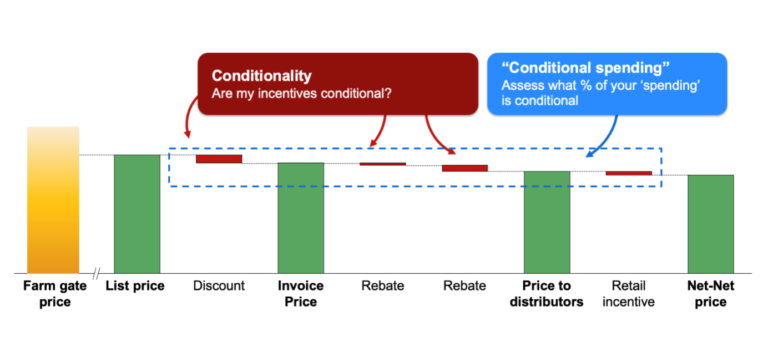
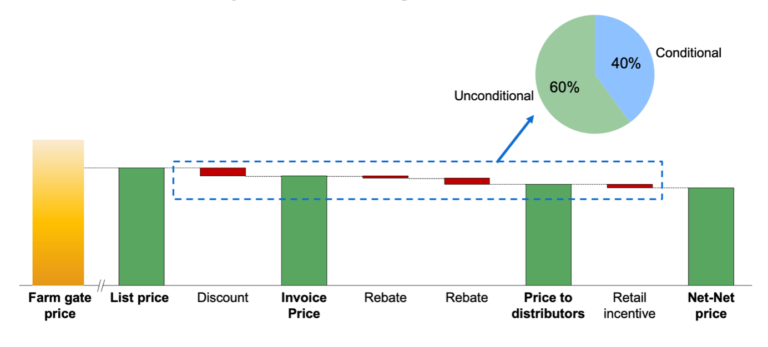
By mapping all elements of commercial spend – from invoice discounts and rebates to retail incentives and promotional support to farmers – you can quantify the total investment (or in other words “spending”) made across the customer relationship.
The next step is to classify each element as either:
- Conditional: earned only when predefined objectives or behaviours are achieved.
- Unconditional: granted regardless of future performance.
This exercise provides a simple but powerful metric:
What percentage of your commercial spend is conditional?
A Useful Question for Every Commercial Team
There is no universal benchmark for the “right” level of conditionality. Generally, the more conditional the better, but you may want to keep some room for unconditionality and for negotiation.
The optimal balance depends on market dynamics, competitive intensity, channel structure, customer relationships, and strategic priorities.
Having said that , every commercial team should be able to answer one simple question:
What percentage of our commercial spend is conditional on customer performance?
If the answer is unclear, that is often the best place to begin.
Understanding the level of conditionality within your commercial policy is not simply a pricing exercise. It is a way of evaluating whether commercial investments are creating measurable behavioural change or merely funding the status quo.
The first step is measurement. The second is deciding whether your commercial spend is working as hard as it could.
Get In Touch
Need assistance with your pricing? Reach out to our team at info@agpricing.com. We’re here to help and respond promptly. Let’s grow together!